




Nossa Co-fundadora Hannah Maruci assina o artigo “Desafiando o status quo: liderança feminista e transformação política no Brasil” na revista internacional Gender & Development. O trabalho reflete sobre o trabalho da A Tenda das Candidatas que desde 2020, tem formado lideranças feministas para ocupar espaços de poder e disputar cargos eletivos na política brasileira. Nos últimos quatro anos, a organização capacitou mais de 300 mulheres — majoritariamente mulheres negras e LGBTQIA+ —, criando uma rede nacional de mulheres feministas na política, a Rede A Tenda.
O artigo argumenta que essas lideranças feministas politicamente formadas, que se organizam em redes de solidariedade, desafiam as formas tradicionais, brancas e masculinistas de fazer política, transformando, assim, o cenário político. Sua presença como lideranças ativas, que questionam seus partidos políticos e as desigualdades de gênero e raça que eles perpetuam, expõe as ineficiências e desigualdades enraizadas em séculos de política tradicional.
Para explorar essa transformação, o artigo analisa entrevistas em profundidade com lideranças feministas que participaram dos programas de formação da Tenda e que concorrem nas eleições municipais brasileiras de 2024, além de dados quantitativos de formações anteriores e informações do Tribunal Superior Eleitoral (TSE).
A partir da perspectiva da Liderança Transformadora pelos Direitos das Mulheres (TLWR), da Oxfam, a pesquisa busca compreender como esses programas de formação têm modificado suas práticas políticas, fortalecido-as como lideranças feministas e contribuído para a construção de um futuro político mais equitativo e inclusivo no Brasil.
A publicação completa está em inglês e disponível em https://www.tandfonline.com/doi/full/10.1080/13552074.2025.2503655.
Porém, para quem desejar, também disponibilizamos o texto abaixo:
Challenging the status quo: feminist leadership and political transformation in Brazil
Brazilian political landscape
The inclusion of women in Brazilian politics, particularly Black and LGBTQIA+ women, still faces significant obstacles, reflecting a profound gender and racial inequality in the political system. Historically, Brazilian politics has been dominated by white men from higher social classes, with greater access to financial resources and support networks (Gonzalez 2020). Data from the Superior Electoral Court (TSE) shows a worrying under-representation of women at all levels, with Black women occupying a tiny pro portion of elected positions. This under-representation is aggravated by political vio lence, which takes many forms, from threats and verbal aggression to physical and sexual violence, often amplified by social media (Aflalo 2024). The lack of access to finan cial resources for campaigns also contributes to this inequality, limiting the chances of women, especially Black women, to run and be elected.
Currently, women account for 18 per cent of those elected to the Chamber of Deputies and 18.5 per cent to the Senate (TSE 2024). The situation is even more unequal when we integrate the intersectional marker of race with that of gender: Black women make up only 6 per cent of federal deputies and 1 per cent of senators (TSE 2024). Indigenous and transgender women only make up 1 per cent of those elected (Figure 1).
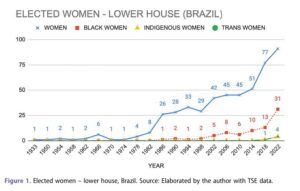
Figure 1 shows the evolution in numbers of women elected to the Chamber of Deputies in Brazil since 1933, the first election in which women could vote and be voted for. It is possible to see the under-representation of women in general, who to date have not even reached a fifth of those elected (out of a total of 513 seats) and, above all, the disparity between them and the group of Black women, who are even more pro foundly under-represented, remains (Aflalo 2024).
It is important to remember that political campaigns are expensive and although they do not guarantee electoral success, money is a necessary factor for an effective campaign. If women, especially Black women, have less access to financial resources and at the same time are the most under-represented, the democratic account does not add up.
These data, which are not exclusive to Brazil, have historically served to justify the need to think of political under-representation as a problem. The discomfort with the obvious disproportionality between population groups and elected representatives, what Miguel (2000) called an ‘intuitive justice’, is directly related to the idea of descrip tive representation proposed by Pitkin (1967). 1 Descriptive representation is based on the idea that parliamentary representatives should serve as a mirror of those they rep resent, respecting their composition. However, this type of representation was reduced to merely ‘counting the numbers of women present’ (Childs and Lovenduski 2013, 493) and interest migrated from the issue of descriptive representation to substantive rep resentation. Substantive representation has been the focus of studies on political rep resentation for at least two decades and focuses on what representation produces, rather than who produces it – and the relationship between the two. The defence of this type of representation was central to justifying the work of feminist theorists who denounced the under-representation of women. Even though descriptive rep resentation is now considered insufficient, it is still used to support affirmative action policies, such as electoral quotas, and to justify the need for the presence of certain groups and characteristics in institutional politics. Therefore, it has not beenabandoned but understood as a means of serving ‘as a measure of substantive represen tation’ (Childs and Lovenduski 2013, 495).
The demands for more women in politics mentioned so far started from the defence of descriptive representation and therefore gave priority to the issue of the presence of women in institutional spaces, understanding that this would produce changes in the way politics was done. The idea that the existence of women, with their presence (Phillips 1995) and perspective (Young 2000), in a predominantly male-dominated environment would transform the dynamics of institutional politics, contributed to linking descriptive and substantive representation. This relationship is the subject of recurrent analysis in feminist literature and is also observed in the dynamics of the institutions themselves.
This transformation is reflected both in the re-dimensioning of institutional spaces – an example of this is the construction of the first women’s bathroom in the Brazilian Senate in 2016 – and in the content of legislative activities – in which the articulations of women’s caucuses to pass laws on common issues, such as violence against women, stand out (Aflalo 2024). Thus, descriptive and substantive representation are interlinked and their relationship needs critical analysis.
History of affirmative action laws
In recent years there have been some important advances in public policies for the dis tribution of electoral resources. Table 1 shows the history of affirmative action laws for women and Black people in politics.
Transparency and accountability of electoral funding shaped these positive policy shifts. Campaign financing became public in 2017, when a public electoral fund was cre ated to be divided between the political parties who would then distribute it among their candidates. At the same time, corporate donations to electoral campaigns have been banned. This measure is considered positive as one of the factors that hinders women’s access to financial resources for their campaigns is that they have less entry into the social circles of potential donors, such as company CEOs. When the electoral fund becomes public, this access theoretically becomes more democratic, since it does not depend on personal connections involving the circulation of money. At the same time, because it is public money, there is a need for transparency on the part of the political parties towards the population and the state. This resulted in the determination that at least
30 per cent of these resources be directed to women’s campaigns and that the resources be distributed proportionally between campaigns led by Black and white political candidates.
These measures are important and have produced positive results that tend towards greater democratisation of resources, as shown by Ramos et al. (2020). However, the pro blem is far from being solved. This is because the existence of the rules does not mean that political parties comply with them, and what has been systematically witnessed in recent years is the circumvention of the law and the subsequent application of amnesties that forgive this non-compliance (A Tenda das Candidatas 2022). This dynamic gener ates the perception that the law does not need to be complied with, and political parties continue without investing adequately in the candidacies of marginalised groups and without being penalised for it.
Furthermore, the lack of consideration of the intersectionality of gender and race in affirmative action laws to increase women’s participation in politics reflects a systemic failure to address the experiences of Black women. ‘Racism and sexism that structure social relations in the country and establish the backdrop against which the political par ticipation of black women takes place’ (Rios, Pereira, and Rangel 2017, 41) is neglected in affirmative action laws in politics.
Feminist movements have historically pressured political systems to recognise inter sectional experiences, influencing the state political society and producing policies (Alvarez 2014). One example is the gender quotas policy, which is a result of the inter action of the feminist movement with the legislature in the 1990s. However, some pro blems remain within this legislation. The first one is its unawareness for intersectionality, the second is that political parties have systematically failed to comply with this law.
What we will show in this article is the way in which feminist leaders organised in a network are able to influence the institutional events and processes – such as electoral institutions and political parties – in order to guarantee (1) the existence of affirmative policies and (2) that the political parties will comply with those laws.
The ‘problem’ of leadership
For many years, one of the widespread explanations for women’s political under- representation was their perceived lack of interest and under-preparation. These two points, however, have been and can be easily refuted. The lack of interest is contrasted with the active presence of women in political parties – making up almost 50 per cent of the membership – and their increasing availability of candidacies (TSE 2024). But what we want to go into in this analysis is the supposed ‘under-preparation’.
Political parties have historically invested less in the candidacies of women, especially Black women. Since they have remained on the margins of politics for so long, Black women have fewer tools in the electoral game than white men, who have mastered the formal and informal rules of the electoral run, since they have been playing it for centu ries (Ramos et al. 2020).
What is crucial to acknowledge is that women do politics daily: many are leaders in their communities, in their families, and in their neighbourhoods. However, this kind of politics is considered less important. The discredit that women doing politics on a daily basis face also has a major impact on their self-image, which makes it difficult for them to see themselves as candidates and potential elected officials. Research by A Tenda das Candidatas (2023) shows that women find it difficult to see themselves as political leaders, but that after undergoing the training their percep tion has changed.
Among the 585 women who enrolled in A Tenda’s training between 2020 and 2021, women found it difficult to perceive themselves as political leaders. Of the total data, it was observed that only 72.8 per cent of women said they considered themselves political leaders, while 27.2 per cent did not consider themselves leaders. However, when asked if they actively participated in political groups or associations, the percentage of those who said yes was higher, almost 75 per cent. This shows that there is a mismatch between working in associations and groups, and the self-perception of being a political leader. When we look at the racial breakdown, this mismatch is even greater: all white women who said they actively work in political spaces said they considered themselves political leaders, while among Black women in the same situation, 95 per cent considered themselves leaders.
Although the situation described so far may seem bleak, the actions of feminist leaders have demonstrated an ability to challenge this status quo, promoting significant trans formations in Brazilian politics. This article analyses the impact of feminist leaders in transforming the unequal status quo in Brazilian politics. To do so, we will focus on the impact of the political training and network building offered by the NGO A Tenda das Candidatas on the transformation of Brazilian politics. Our analysis is based on the concept of Transformative Leadership for Women’s Rights (TLWR), developed by Oxfam, understood as ‘an approach strategy for social justice’ (Oxfam 2014, 4). We will dive into the question of how the training of feminist leaders to run for office and the development of a network of feminist leaderships based on solidarity are efficient ways of challenging and transforming ‘power relations and structures’ (Oxfam 2014, 4). A Tenda das Candidatas works towards fostering a fairer political environment characterised by gender and race equality. Since 2020, the organisation has trained more than 300 women, mostly Black and LGBTQIA+, creating a national network of feminist leaders, A Tenda Network, of hundreds of women from all regions of Brazil. A Tenda’s political training provides not only technical tools for electoral campaigns, but also promotes an important transformation in women’s self-perception and capacity for political action, encouraging women to position themselves as agents of transform ation and to recognise themselves as leaders.
The political training consists of cycles of training that take place online before and after elections. The longer cycle, which aims to prepare the leaders to run for office, has the dur ation of one year and starts the year before elections. It comprises 30 classes with specialists from all areas that are needed for a political campaign (i.e. political marketing, social media, media training) and with professionals that focus on their emotional strengthening, which is vital to run for office. At the end of each class, the leaders have a reserved space to ask ques tions to the specialist and share experiences with the other leaders from different parts of the country. When they conclude the training, they are asked to sign a document affirming their commitment to defend human rights, gender and race equality, and climate justice.
After elections, not all women will have been elected. This is expected, but if not addressed in the best way, what happens is that those who have not succeeded may give up politics. In this worst-case scenario, we will lose important leaders who are more likely to win the next elections than one who has never competed. To address this, A Tenda das Candidatas holds a training cycle focused on non-elected women, in order to keep feminist leaders in the political game and to give them the support and a sense of belonging to a network of women in politics, which is A Tenda Network.
A Tenda Network is a collective of more than 100 women leaders from all over Brazil who have gone through A Tenda das Candidatas’s training and who are committed to equity and human rights. This network is based on important TLWR fundamentals on collaborative leaders, such as the belief that ‘power is greatest in a collective team’ (Oxfam 2014, 10) and the principle of ‘openly sharing information and knowledge’ (ibid.). This network not only offers practical political support, but also provides a space for acceptance and emotional support, which is essential for dealing with political violence and the pressures of the system.
Common to all those leaders are the domestic and family responsibilities in women’s political lives, as most of them experience what we can call a fourfold journey. The research highlights the importance of considering the personal, political, and social dimensions of the work of these leaders. Our argument is that well-prepared feminist lea ders are able to challenge the traditional political system, thereby promoting greater rep resentation and equity, especially for Black and LGBTQIA+ women.
Methodology
The analysis of the impact of political training and the construction of a network for feminist leaders on the status quo in Brazilian politics will be carried out mainly through the information provided by A Tenda das Candidatas. To this end, we used a mixed research methodology, combining analysis of in-depth interviews with feminist leaders, quantitative data from surveys carried out with feminist leaders from A Tenda das Candidatas at different times, as well as quantitative data from the TSE, in order to gain a comprehensive understanding of results.
The qualitative approach allows for a deep and contextualised understanding of the experiences and strategies used by leaders to transform the political status quo, exploring the nuances and complexities of these women’s political actions (Kvale and Brinkmann 2009). In-depth interviews allow for the construction of rich and detailed narratives, revealing the motivations, challenges, and coping strategies of these leaders.
Interviews were conducted with 15 political leaders from the A Tenda Network who ran in the 2024 municipal elections. All of them will have their identities protected. For this reason, we will always use a random letter to refer to the leaders, identifyingat most their race and state of origin. The purpose of this choice is to protect sensitive information contained in the reports, especially considering that most of the leaders con tinue to belong to the same political parties they mention in the interviews. Although the individual identity of each of them will not be revealed, it is important to detail the profile of the group of interviewees here, since they are important in our analysis. Of the 15 interviewees, 13 are Black women – of whom two are Quilombolas, one is an Indigenous woman, and one is a white woman. Regarding age range, two of them are under 25 years old, while the others have an average age of 35. Regarding gender identity, two are trans women and 13 are cis women. Regarding sexual orientation, three are heterosexual women and the other 12 belong to the LGBTQIA+ group.
For the analysis, we used an interpretivist qualitative approach (Flick 2018), focus ing on themes and the construction of narratives based on the data. Thematic analysis consists of identifying patterns and recurrences in the interviewees’ speech in order to build analytical categories that shed light on the experiences and strategies used by the leaders to transform the political status quo. Thus, interpretivist analysis seeks to understand the meaning of the speeches in the context of women’s political struggle, considering power relations, gender and race inequalities, and the coping strategies used by the leaders.The construction of narratives based on the testimonies allows us to understand the complexity of the individual trajectories and the interaction between the personal, politi cal, and social dimensions of these women’s actions. These narratives were fundamental to understanding the richness and complexity of these women’s entry into politics. The interviews revealed a diversity of paths and experiences, demonstrating how political training, building support networks, and strategic articulation are crucial elements in the struggle for greater representation.
All the analysis carried out in this article was developed in the light of feminist the ories, allowing for a deeper interpretation of the narratives. To analyse the main obstacles regarding women’s political participation, Brazilian feminists who examine the division between public and private (Biroli 2016), specially on the basis of gender and race (Astro labio dos Santos 2023; Carneiro 2019; Rios, Pereira, and Rangel 2017) are of the most importance. As Carneiro (2019) points out, if the sexual division of labour has shaped women’s roles … , the racial division of labour establishes different roles and functions within the female group, remembering that the obstacles posed by the patriarchal struc ture are different for women depending on their race. Those theories will help the under standing of the political and social place of the leaders and of the impact of those contexts in their political trajectories.
First, we will systematise, based on the data presented, the main difficulties and bar riers faced by feminist leaders in politics and the mechanisms for dealing with these bar riers. Thereafter, we will seek to demonstrate how these leaders are strengthened by the training and network provided to them by A Tenda das Candidatas. We will then show how this results in a transformation of the status quo of Brazilian politics, considering Oxfam’s TLWR’s principles. Finally, we will summarise the main findings and results of the research.
Challenges and coping strategies
The leaders interviewed 2 described a series of challenges they faced during the elections, including political violence based on gender and race, the difficulty of accessing financial resources, and the consequences of the division between the public and private spheres.
To give some examples, A., a Black woman from the north-east of the country, reported the delay in receiving funds from the party, forcing her to use her own resources in order to start her campaign:
We had a hard time from the start of the campaign until the money arrived. I thought: the cam paign is going to start, everything is going to be fine, the money is going to arrive, it was already on the party table, and nothing arrived, nothing arrived. So, yes, we still had to put up our own money, not just me, but some other people on the team. Both to pay for materials and for basic things like feeding the people who were going to mobilise.
N., a Black trans woman from the south-east of the country, and Y., a Black woman from the north of the country, highlighted the fragility of party structures and the difficulty of accessing resources for candidates from minority groups, as well as the lack of political support from the party:
I asked the party for an amount, because I had a budget of what I knew was necessary. They gave me money, but it was far below the minimum needed to run a competitive campaign. And I know that this has to do with me being Black, with me being young. (Y.)
The difficulty of obtaining support from the party, especially in the interior of the state, as well as vote-buying, and the political violence suffered was pointed out by I., a white woman from the south of the country. D., a Black trans woman from the south-east, describes the party as having ‘passed her by’, putting her in a lower priority group and not investing in her campaign. Many highlighted the political violence suffered by their own parties. Political violence, especially gender and racial violence, emerges as a significant obstacle, requiring coping strategies and protection mechanisms. In this section, we will delve into each of those obstacles described in the interviews by themes.
Public versus private
The division between public and private has proved to be detrimental to women in poli tics, especially Black women. The interviews revealed the complexity of the experience of feminist leaders, who have to reconcile the demands of domestic and family life with the demands of public life, as well as having to ensure that they and their families can support themselves. This ‘fourfold journey’ – paid work, domestic care, family care, and political participation – has had a direct impact on these women’s ability to act politically.
Biroli (2016, 721) argues that ‘The sexual division of domestic labour implies that women have less access to free time and income, which has an impact on their possibi lities for political participation and the patterns that this participation assumes.’ This is crucial for thinking about the political participation of women, especially Black women, who have historically simultaneously performed paid and unpaid care labour,given the logic of the sexual and racial division of labour. In Brazil, gender norms mean that being a woman presupposes a place in the sexual division of labour that dispenses with any kind of autonomy and independence gained over the years. Those gender stereotypes reinforce the idea that women are less likely to occupy positions in insti tutional politics (Biroli 2016, 722).
This analysis is affirmed and reinforced by the data on women seeking election. The sur vey carried out by A Tenda das Candidatas (2023), which included responses from almost 800 women who sought the organisation’s political training between 2020 and 2022 with a view to running for election, shows that, in 2020, 50.5 per cent of those registered said they had become responsible for care activities during the pandemic. Of these, half said they were also mothers. In both years, the racial perspective proved crucial: ‘Among the women who registered, black women, more than white women, were primarily responsible for care activities during the pandemic’ (A Tenda das Candidatas 2023, 77).
Thus, the sexual division of labour is also racial, which creates different conditions and political possibilities for white women and Black women. Biroli goes further by saying that the sexual division of labour produces gender:
This is why I understand that the sexual division of labour produces gender, even though it does not do so in isolation. It is an important part of the dynamics that shape the female–male duality, while at the same time positioning women unequally according to class and race. (Biroli 2016, 739)
One of the interviewed leaders, a Black woman from the north-east of the country, A., who took over the responsibility of caring for her sick mother, at a crucial moment in the campaign, demonstrates the difficulty of reconciling the demands of personal life with the demands of public life. A. also highlights the need to share the care of her mother and father with her siblings during the campaign: ‘I don’t have children, so as far as care is concerned, I share care with my mother and father and with my siblings.’ This division of responsibilities, although necessary, implies an overload of work and a reduction in the ability to dedicate oneself to the campaign.
The sexual and racial division of labour is a constant barrier between women and poli tics, since participating in party politics, running for office, and campaigning are activities that are, in most cases, unpaid and involve the accumulation of another day’s work, in addition to external and domestic work. Thus, there is an intricate relationship between gender stereotypes, the sexual and racial division of labour, and the under-representation of women, especially Black women, in politics, since ‘the weight of social inequalities seems to feed back into inequalities in politics, and vice versa’ (Rios, Pereira, and Rangel 2017, 43).
Pressure and negotiation: campaign financial resources
By demanding their inclusion in politics despite the structural barriers, feminist leaders actively challenge them. They use their political training and support networks to pressure their parties to provide the support – both political and financial – that they need to be viable candidates. It is important to highlight here that when we speak of the ‘status quo’ of Brazilian politics, we are referring to the current inequality illustrated in the previous sections and that this scenario is largely sustained by political parties.
In Brazil, political parties are responsible for selecting, recruiting, and launching can didates in elections. In addition, since the 2018 elections, they have been responsible for distributing the Special Campaign Financing Fund, the billion-dollar public fund that was established to finance campaigns that accompanied the ban on donations from legal entities to electoral campaigns. Therefore, parties have great power and influence over which candidates will receive the greatest investment – political and financial – and who are most likely to be elected.
Therefore, we argue that political parties play a strategic role in the political represen tation – or under-representation – of women and Black people and in bringing these groups closer to or further away from electoral politics. According to Sacchet (2020, 72–3), ‘Both the role that parties play as mediators of electoral rules and their resistance to initiatives that aim to boost women’s political participation are evident’. This means that the response of parties to affirmative action with the aim of boosting the partici pation of women and other marginalised groups in politics can provide some answers about the role that these organisations have played in this regard. And these responses, unfortunately, have been aimed at circumventing the initiatives in question, as we explained previously.
As Sacchet (2018, 20) points out, ‘Brazil is a good example of how weak regulation of political parties can make quotas ineffective’ which, according to her, ‘allowed parties to avoid [fulfilling quotas] between 1998 and 2014’ (Sacchet 2018, 37). Candidacy quotas are an important indicator for understanding the intention of political parties to promote an increase in women’s political representation, since ‘the number of female candidates can not be disregarded as a variable to judge the level of responsiveness of parties’ (Sacchet 2020, 80). However, the increase in candidates is not enough to affirm that the party intends to elect more women, since, for this to happen, there is a need for political and financial investment in their campaigns, and the parties’ preference has been for can didates who are white men, as the data and a simple look at the Brazilian parliament allow us to conclude (Sacchet 2020, 80).
A quantitative survey conducted by A Tenda das Candidatas (2024) with 128 human rights defenders interested in post-election political training for non-elected candidates provides striking data. Of all the women who responded to the questionnaire, 67.2 per cent reported problems in receiving funds from parties for their campaigns and, of these, 13.3 per cent did not receive any. The analysis of the interviews reveals the com plexity of the challenges faced by the candidates. The lack of financial resources is a recur ring obstacle, as L. points out:
I didn’t think it was good [what I received], but considering that we had nothing, it was a huge relief [to have received something].
She reported that the money had taken a long time to arrive and that at some point she believed she would have nothing to carry out the campaign. She explains that the strategies taught by A Tenda to pressure and negotiate with the political party were pivo tal to guarantee that the money would arrive, even though at a later time.
A similar situation is described by K., a Black woman from south-eastern Brazil, who explains that she did not understand the reason for having received so many fewer resources than the other candidates on her ticket. K. reportedly used a strategy taught by A Tenda, but her political party was evasive in its responses: ‘So they explained the criteria [to divide the money], but it didn’t make sense because it didn’t match reality.’ The lack of resources and the pressure to adapt to the party’s expectations generate frus tration and discouragement, as K. reports. Some leaders reported serious consequences due to political parties’ promises that were not met. The experience of Y., a Black woman from the north of the country, who lost team leadership due to the non-payment of promised resources, also shows the precarious working conditions of women in pol itical campaigns.
The inequality in access to resources is even greater for Black and LGBTQIA+ women, as M., a Black lesbian woman from Rio de Janeiro, points out:
I think that if it had been the campaign of a straight white man, this wouldn’t have happened, because people think three times before doing something.
explained that she received less money than expected and that it arrived later in the campaign. Therefore, underfunding of campaigns is also aggravated by the delay in the transfer of public funds, which harms the visibility and ability of candidates to act. D., when describing the difficulties faced during the campaign, illustrates this reality:
the delay in funding is one of the things … if we had had funding from the beginning of the cam paign, we would have had a team on the ground from the beginning of the campaign too.
The lack of a complete team from the beginning and the delay in receiving funds from the party harmed the electoral performance of many candidates.
Despite party negligence, what the practice of feminist leaders shows us is that net working and political training can be important tools for overcoming this constant barrier. L., a lesbian Black woman from Bahia, exemplifies the use of the guide ‘Excuses Don’t Pay for Campaigns’, a manual developed by A Tenda das Candidatas to help women pressure parties that have not sent them funds for their campaigns, as an effective advocacy tool to pressure the party to release funds. I., a bisexual white woman from the south, describes how building a support network allowed her to pressure her party to secure funds for her campaign, even in the face of internal resistance. She explained that showing that she was not alone and that she knew her rights and had support made her stronger in face of the political party. Along the same lines, M., a Black lesbian woman from the south-east, highlighted the importance of political articulation carried out in conjunction with the organisation to ensure access to resources and visibility.
What we conclude here is that feminist leaders organised in a network that provides information and support are able to confront institutional structures to have their politi cal rights guaranteed. When they pressure their political parties to comply with the elec toral law (that determines that they should, as women, receive a percentage of the electoral fund), they are both pushing for the change of the political party and the elec toral institution.
Gender and racial political violence
Interviews conducted with political leaders from A Tenda Network reveal how gender and racial political violence directly impacted their campaigns. The candidates faced various types of violence, from attacks on social media to threats in person. One point that drew attention was the fact that, even though most of the interviewees did not report cases of pol itical violence on the streets and the internet during the elections, they affirm that the vio lence came from their own political parties, which were supposed to be their allies.
A Tenda das Candidatas’s (2024) survey with non-elected candidates in the 2024 elec tions showed that 44.6 per cent of them reported having suffered political violence based on gender and race by their political parties. When asked if they suffered any type of pol itical violence based on gender and race during the campaign, 59.1 per cent said they had. L., a Black lesbian woman from Bahia, describes how she was prevented from speaking at a coalition rally, being interrupted by the co-ordinator of the federation:
The co-ordination people tried to remove me from the stage, and I said, ‘I’m from here’. Trying to explain that I was a candidate and had the right to speak. The co-ordinator replied ‘Oh, I didn’t know, there’s no way to let you speak now.’
She felt cornered, but she knew what was happening and that she also had the right to speak. L. reported that she stood up for herself and managed to grab the microphone, but that the co-ordinator kept hitting her on the back repeatedly to get her to finish speaking, which made her feel embarrassed and hindered her speech at a crucial electoral moment. This situation, an obvious episode of political violence, limited her ability to communicate with voters and present her proposals. Furthermore, it illustrates the difficulty of having a voice and being heard within one’s own party.
Political violence profoundly affected the mental health of the candidates, leading some to question the possibility of continuing in the political struggle. As K., a Black woman from south-eastern Brazil, reports, the pressure and lack of support from the party led to frustration and discouragement. The experience of I., who faced an internal coup in her organisation during her previous campaign and received several threats, also demonstrates the difficulty of remaining firm in the face of political violence. Political violence has the power to make the candidate question her own ability:
Is this really it? Can she really handle it? Is she really a candidate? Will it really work? Will she really get the votes? Will she really be able to organise? Will she really be able to … ? Those things start to get into your mind. (M., lesbian Black woman from Rio de Janeiro)
In addition to episodes of political violence from their own parties, some of the leaders also had to deal with external attacks. M. describes a series of online and in-person attacks, including a false accusation of assaulting a child after M.’s political campaign material was destroyed:
We had a situation where someone tore up our material here in the city … it was published in the Globo newspaper, with my name saying that my team had assaulted a child.
This experience demonstrates how political violence can be used to delegitimise the work of candidates and undermine their credibility. Despite the challenges, the leaders demonstrate resilience and perseverance, continuing to f ight for a more just and inclusive politics. F., a Black woman from Goiás, when describing her experience, tells that although the political violence was demotivating, she felt strong and prepared after a year of political training with A Tenda, which made her keep going:
I’m very much one to face the situation, right? I’m not one to be sad, to … I’m more one to face it. And this confrontation is never about … attacking the person.
She also reports that:
when the electoral process ended, I had to console my son, I had to console my wife, I had to console my mother. Everyone thought I was going to win.
What I perceived from their speech was that even though racial and political violence were inevitably present in their campaigns, the fact that they were both trained – in a way that they knew their political rights and were able to confront their political parties when needed – and supported by a network of other feminist leaderships – with whom they could exchange experiences and information during the electoral process, gave them strength to keep going.
Feminist leaders and the challenge to the status quo
All of the challenges illustrated above demonstrate how the political insertion of women is complex and can often lead to withdrawal. What we argue here is that feminist leaders who are properly supported can not only preserve and succeed in the electoral race, but also shape a new way of doing politics that challenges the exclusionary status quo of Bra zilian politics. The feminist leaders interviewed used a combination of strategies to chal lenge the status quo, combining political training, network building, pressure on parties, social mobilisation, and remarkable resilience. Their actions demonstrate the capacity to transform the political system, even in the face of significant barriers, contributing to a more fair and representative politics.
In this section, we will analyse how A Tenda das Candidatas contributes to this trans formation from two points of view: ongoing political training and the formation of the A Tenda Network, a solidarity network among women leaders from all over Brazil.
Political training and self-perception of leaders
The political training offered by A Tenda das Candidatas is a crucial element in the tra jectory of leaders, equipping them with the tools and knowledge to navigate the complex Brazilian political scenario. This is ongoing training that is not limited to the pre-election period. The longest training programme lasts 30 classes, spread over a period of one year, 393 GENDER & DEVELOPMENT and begins the year before the election. After this training, those who have completed 70 per cent or more of the classes are eligible to be selected for personalised pre-election mentoring, which also involves their team. Thus, ten women are selected to be mentored, which involves meetings and training conducted by A Tenda’s experts directly with these leaders.
During the election period, A Tenda does not make any direct contact with the can didates, dedicating itself to social awareness and political and legislative advocacy. Train ing sessions only resume after the elections are over. With the results achieved, some will have been elected, others will have become alternates, and others will not have been elected. In the 2024 elections, for example, four leaders were elected and 17 became alternates.
The focus of the next training session, then, becomes those who were not elected. This is because the organisation understands that leaders who have gone through an electoral cycle will be more able to run in the next one. However, if they do not receive support in this post-election period, they tend to give up on politics. The role of training is not only to ensure that they do not give up, but also to ensure that they feel motivated and can learn from their mistakes and successes, in order to build themselves as even more viable candidates for the next elections. Therefore, it is important to note that when we talk about ‘political training’ here, we are talking about a complex cycle, which involves many stages and not just a few classes or training sessions. It is only through this engagement that it is possible to build a network of solidarity among women in politics. Therefore, it is not just about practical tools, but also about emotional and moral support for these leaders who often do not feel like they are leaders. As we mentioned at the beginning of this article, the self-perception of women, especially Black women, is crucial for them to position them selves as candidates. Therefore, training also plays a role in this area, so that in this process they also build their images for themselves as potential candidates.
In the interviews, the importance of training for the electoral results obtained was unanimous. One of the leaders, A., a Black woman from the state of Pernambuco, in the north-east of the country, highlights training as fundamental for her first candidacy: ‘Learning how to campaign is something that I owe 90 per cent to Tenda.’ She highlights training as fundamental for her first candidacy, providing tools to deal with the team’s inexperience and to negotiate with the party. She also adds, ‘training provided tools that were fundamental for us to have a successful campaign’. F., a Black woman from the centre of the country, highlighted training as:
Fundamental, very important, so I didn’t go into the process unaware you know? I knew more or less what was going on, although there wasn’t much I could do due to the financial situation.
A young Black leader from northern Brazil, Y., highlighted the importance of training in preparing her campaign, providing tools for negotiation and mobilisation, emphasising that the mentoring period – in which some leaders received personalised training for their entire team – was ‘important especially for my team’.
Still on the subject of mentoring, N., a Black and trans woman from the state of São Paulo, emphasised the celebratory tone of Tenda’s mentoring, which encouraged her to face the challenges of politics: ‘A Tenda has a celebratory tone … which is not an empty celebration, it is a possibility of achievement.’ This positive and encouraging approach is essential to overcoming the barriers imposed by sexism and racism in politics. Training, therefore, is not limited to the acquisition of technical skills, but also promotes a trans formation in women’s self-perception and capacity for political action.
As L., a lesbian Black woman from Bahia, highlights, the training provided by A Tenda ‘gave me a lot of confidence, to participate initially, to train myself, to participate in elec tions, to help other candidates who did not have the possibility of having someone behind them to help, co-ordinate, and articulate’. M., a lesbian Black woman from Rio de Janeiro, reinforces this idea by mentioning that the training provided by A Tenda left her ‘with a sense of accomplishment. We really do not walk alone, we walk with other people’, demonstrating the effectiveness of the training process in strengthening women’s politi cal action.
The training promotes a transformation in women’s self-perception and capacity for political action, equipping them with tools to negotiate with parties and deal with politi cal violence and lack of support. Thus, feminist leaders do not limit themselves to parti cipating in the political system, but also in actively challenging it. They use political education and support networks to pressure parties to comply with gender and race quotas and to distribute financial resources more fairly. I., a bisexual white woman from the south, described how building a support network allowed her to pressure her party to secure resources for her campaign, even in the face of internal resistance. In the same vein, M., a lesbian Black woman from the south-west, highlighted the impor tance of building a strong social base and organising politically to ensure access to resources and visibility.
These experiences show that, based on the empowerment promoted by political edu cation, these women challenge the exclusionary structures present both in society as a whole and in political parties. We talk about training that is not limited only to the acqui sition of technical skills for electoral campaigns, but that contributes to the construction of electorally viable leaders based on their self-perception as leaders.
The power of the network: solidarity and political articulation
A Tenda Network emerges as an example of how organisation and solidarity can be powerful instruments for political transformation. The network in question currently has more than 100 leaders from all regions of Brazil and from different parties, and has played a supporting role among women, building a way of doing politics that is differ ent from that which has been done for years by men, based largely on competition.
These women are together in a WhatsApp group, where they constantly exchange experiences, in addition to being brought together in meetings proposed by A Tenda to organise collective actions on issues related to women in politics. One of the main actions in this sense is ‘Neon September’, that takes place on the streets and on social media simultaneously, in which leaders raise awareness among the population about pol itical violence based on gender and race. The action took place in 2023 and 2024 and had a great impact, having led to the introduction of a bill that establishes the month of Sep tember as the official national month to combat political violence based on gender and race.
Although the interviews reveal the complexity of the candidates’ experience, marked by significant challenges, it also shows moments of great strength and solidarity. The possibility of counting on other women in politics and the creation of a support network was highlighted in the interviews as key points for leaders’ choice to remain within insti tutional politics. N., a Black trans woman from São Paulo, emphasised the network as a space for solidarity and the exchange of experiences, allowing leaders to overcome the feeling of isolation and strengthen their political actions. This is an important factor if we consider that women in politics are encouraged within their own parties to compete with each other. By being part of a solidarity network among women leaders, who have in common being feminists and defenders of human rights and who are part of different parties and currents within these parties, they begin to understand co-operation as an important element. This collective action also causes leaders to build a different self-per ception about themselves and their political narrative. A. emphasised the network as fun damental to the construction of a political figure.
This construction had a direct impact on how campaigns developed in 2024. Y. mentioned the network as fundamental to the construction of a campaign and to obtain political support, especially in times of crisis. D., a Black and trans woman from Rio de Janeiro, highlighted the importance of the network for emotional support and for the construction of a more-cohesive and efficient campaign, highlighting the importance of mutual support and the exchange of experiences among leaders. In this sense, I. also highlighted the importance of a solidarity network for exchanging experi ences with women from different parties, demonstrating the strength of women’s solidar ity in politics.
The network action also appeared in the testimonies as a way to counter challenges, such as the lack of party support. L., a lesbian Black woman from Bahia, highlighted the importance of the network for visibility and obtaining resources:
I think that the visibility, you know, the visibility that you gave us and knowing that there are other people who are in the same situation as me within the parties being vulnerable, being invisible and not receiving investment, that we know this so we can try to fight to achieve it.
The interviews revealed the resilience and persistence of feminist leaders in the face of adversity. What we argue is that the constant encouragement and support they received from the organisation were crucial for them to decide to remain in politics and contribute to changing the Brazilian political landscape. Despite political violence, lack of resources, and internal resistance within the parties, the leaders demonstrate a strong commitment to the fight for a more just and inclusive politics. K., a Black woman from south-eastern Brazil, when describing her experience in the campaign, illustrates this resilience: ‘I thought about it, but … you can’t give up, no.’ For K., the A Tenda Network was fundamental for her not to give up her candidacy and to continue fighting for her political goals.
This persistence demonstrates the strength and determination of feminist leaders to transform the status quo of the Brazilian political system. The ongoing training and net working of Tenda das Candidatas was crucial for these leaders to receive constant encouragement and support. As L., a Black woman from the north-east of the country, put it:
[With the training and the network] I felt so safe, so safe that I said, I see that I won’t need the party itself to conduct some things.
This shows that they feel welcomed, despite the lack of support they find in the parties. The creation of collective campaign strategies was also crucial to overcoming difficul ties. M., a lesbian Black woman from Rio de Janeiro, highlighted the importance of the favela plenary session that she developed, inspired by the network’s actions:
We held a very good favela plenary session, which brought together our base, which we hadn’t been able to do until now
Building support networks and collective mobilisation are essential to the success of cam paigns. I., an indigenous woman from the south of the country, highlighted the impor tance of collective action in her campaign: ‘My political constructions have always been very much based on their collective form.’ According to the leader in question, the ability to mobilise and articulate different groups and social movements is crucial to expanding the reach of political action and to pressuring parties to meet women’s demands.
A Tenda’s Network extends beyond party boundaries, connecting leaders from different parties and social movements. This is, in some ways, unprecedented in politics, since col laboration between candidates from different parties is not common in Brazilian politics. On the contrary, what we see is internal competition, since the Brazilian political system is based on lists and, therefore, candidates from the same party compete against each other. Therefore, investing in a policy of solidarity and co-operation, whose main objective is to combat inequalities and seek greater social justice, is a way of acting on the status quo. If women who see themselves as feminist leaders work in a network, they gain much more power in their parties, and are thus able to increasingly enter decision-making bodies, and gain bargaining power and visibility. Strengthening a network of feminist leaders, therefore, proves to be an important instrument of political transformation.
Conclusions
Based on an analysis of the Brazilian political scenario, interviews with feminist leaders from A Tenda das Candidatas, and quantitative data from the organisation’s research, we seek to answer whether and how feminist leaders transform the political status quo. We conclude that these leaders are pushing for a change in a historically predominant way of doing politics in Brazil dominated by white men. With the development of their self-per ception as leaders, women are shaping a new way of doing politics. This ‘new way’ pits collectivity and solidarity against individualism, unfair competition, and inequality in Brazilian politics.
In other words, those feminist leaders put into practice what Oxfam’s TLWR calls the concept of ‘power with’, which argues that power must be used with ‘mutual support, solidarity and collaboration’ (Oxfam 2014, 9). Feminist leaders challenge the status quo when they confront their political parties, when they push for changes in the electoral law, when they influence bills of law, when they share information with other women, when they are aware of their political rights and claim for them. With a network of lea ders all over the country, Rede A Tenda, they feel empowered to do so, ‘ensuring account ability of the institutions which are responsible (legally or morally) for dispensing and ensuring justice, protecting civilians, and guaranteeing and protecting the rights of citi zens’ (Oxfam 2014, 8).
To understand how these transformations take form, we have identified the main obstacles to combating the under-representation of women in Brazilian politics. They are: the consequences of the division between the public and private sectors in the over load of women’s work, the lack of willingness of political parties to effectively invest – politically and financially – in women’s candidacies and to share the informal rules of the electoral game, and political violence based on gender and race. In this way, the research highlights the importance of considering the personal, political, and social dimensions of the work of these leaders and the need to build innovative strategies to pro mote the full participation of women in political life.
We then identified the ways feminist leaders can face the obstacles imposed on them. Through the promotion of ongoing political education and the maintenance of a network of solidarity among women in politics, A Tenda das Candidatas fostered an enabling environment to ensure that women can contest institutional politics. A Tenda das Can didatas political training promoted a transformation in women’s self-perception and capacity for political action. The training strengthened the leaders’ ability to question their own parties and the gender and racial inequalities they perpetuate, empowering them to position themselves as agents of change. The formation of a robust solidarity net work, Rede A Tenda, characterised by strong ties among its leaders, was a crucial element in addressing inequalities.
It is from these two points that it is possible to design a different way of doing politics, one that focuses on collective objectives and is built on a logic different from the current one. In this way, feminist leaders can change the status quo of Brazilian politics, moving towards a more just and representative politics. As stated by Astrolabio dos Santos, co-founder of A Tenda das Candidatas, ‘the capacity of these women to engage in politics, despite all the oppression, has shown itself to be what we call resistance here’ (Astrolabio dos Santos 2023, 56).
The research shows that the feminist leaders of the A Tenda Network have the poten tial and are already transforming the status quo of Brazilian politics by addressing and challenging the root causes of inequalities and fostering more collaborative ways of doing politics. This experience demonstrates the transformative power of political train ing and the importance of the construction of support networks for women in politics, paving the way for a more just and egalitarian political future.
Acknowledgements
I would like to deeply thank A Tenda das Candidatas and all the leaders from A Tenda Network who have accepted to be interviewed by me. Your trajectories are inspiring and I fully believe that the trans formations we need to see in politics have already started with you.
ORCID
Hannah Maruci Aflalo http://orcid.org/0000-0002-4820-2942
References
Aflalo, Hannah Maruci (2024) “A que mulher você se refere?”: transformações e permanências do con ceito ‘mulher’ na política brasileira (Doctoral thesis, Faculdade de Filosofia, Letras e Ciências Humanas, Universidade de São Paulo, São Paulo). doi:10.11606/T.8.2023.tde-25062024-182011.
Alvarez, Sonia (2014) ‘Para além da sociedade civil: reflexões sobre o campo feminista’, Cadernos Pagu 43, doi:10.1590/0104-8333201400430013. 399 GENDER & DEVELOPMENT
Astrolabio do Santos, Laura (2023) A sub-representação de mulheres negras na Câmara dos Deputados: o déficit democrático no sistema político classista, racista e sexista (Master thesis, Universidade Federal do Rio de Janeiro, Rio de Janeiro).
Biroli, Flávia (2016) ‘Divisão sexual do trabalho e democracia’, Dados 59(3): 719–754.
Carneiro, Sueli (2019) ‘Mulheres em movimento’, Estudos Avançados 17(49): 117–133.
Childs, Sarah, and Joni Lovenduski (2013) ‘Political Representation’, in Georgina Waylen,
Karen Celis, Johanna Kantola, and S. Laurel Weldon (eds.) The Oxford Handbook on Gender and Politics, New York: Oxford University Press, 489–513. Flick, Uwe (2018) An Introduction to Qualitative Research, New York: Sage.
Gonzalez, Lélia (2020) Por um feminismo afro-latino-americano, Rio de Janeiro: Zahar.
Kvale, Steinar, and Svend Brinkmann (2009) InterViews: Learning the Craft of Qualitative Research Interviewing, New York: Sage.
Miguel, Luís Felipe (2000) ‘Teoria política feminista e liberalismo: o caso das cotas de representação’, Revista Brasileira de Ciências Sociais 15(44). Oxfam (2014) Transformative Leadership for Women’s Rights, Oxfam International.
Phillips, Anne (1995) The Politics of Presence, Oxford: Clarendon Press.
Pitkin, Hanna (1967) The Concept of Representation, London: University of California Press.
Ramos, Luciana de Oliveira, Catarina Barbieri, Hannah Maruci Aflalo, Juliana Fabbron Marin Marin, Ivan Osmo Mardegan, Laís Menegon Youssef, and Vanilda Souza Chaves (2020) Candidatas em jogo: um estudo sobre os impactos das regras eleitorais na inserção de mulheres na política, São Paulo: FGV Direito SP. Rios,
Flavia, Ana Claudia Pereira, and Patrícia Rangel (2017) ‘Paradoxo da igualdade: gênero, raça e democracia’, Ciência e Cultura, São Paulo 69(1): 39–44. doi:10.21800/2317-66602017000100015.
Sacchet, Teresa (2018) ‘Why gender quotas don’t work in Brazil? The role of the electoral system and political finance’, Colombia Internacional 95: 25–54. doi:10.7440/colombiaint95.2018.02.
Sacchet, Teresa (2020) ‘A culpa é dos partidos: desigualdades de gênero em disputas eleitorais’, in Flavia Biroli, Cristina Buarque de Hollanda, Vanessa Oliveira, and Tatagiba Luciana Elias (eds.) Mulheres, poder e ciência política: debates e trajetórias, Campinas: Editora da Unicamp.
A Tenda das Candidatas (2022) Desculpas não pagam campanhas [Excuses don’t pay for campaigns], Rio de Janeiro.
A Tenda das Candidatas (2023) Combatendo a sub-representação de gênero e raça na Política (2020- 2022): o impacto do projeto A Tenda das Candidatas, Rio de Janeiro.
A Tenda das Candidatas (2024) Violência política nas eleições de 2024. Available at: https://www.instagram.com/p/DEzleP6POp3/?img_index=4&igsh=MXBlenVnMWExbnQ1Ng==. TSE (Tribunal Superior Eleitoral) (2024) “Divulgação dos resultados das Eleições 2024”, TSE. Young, Iris Marion (2000) Inclusion and Democracy, Oxford: Oxford University Press7